
1. Founding and Early Beginnings (1962-1969): The Rural Strategy
- 1962: Sam Walton opened the first Walmart store in Rogers, Arkansas.
- Core Strategy: Focused on rural areas that larger competitors ignored, offering “Everyday Low Prices” (EDLP).
- 1969: The company officially incorporated as Wal-Mart Stores, Inc.
Revenue Level: Grew from less than $1 million to approximately $31 million.
Key Business Advancement: Implementation of the Profit Sharing Plan. Sam Walton introduced a program where all full-time associates could share in the company’s profits after one year of service. This was revolutionary in the 1960s retail industry, fostering deep employee loyalty and a culture of “ownership” at the store level.
2. Regional Expansion and Going Public (1970-1979): Scaling Up
- 1970: Walmart went public, and its first distribution center opened in Bentonville, Arkansas.
- 1972: The company was listed on the New York Stock Exchange (NYSE).
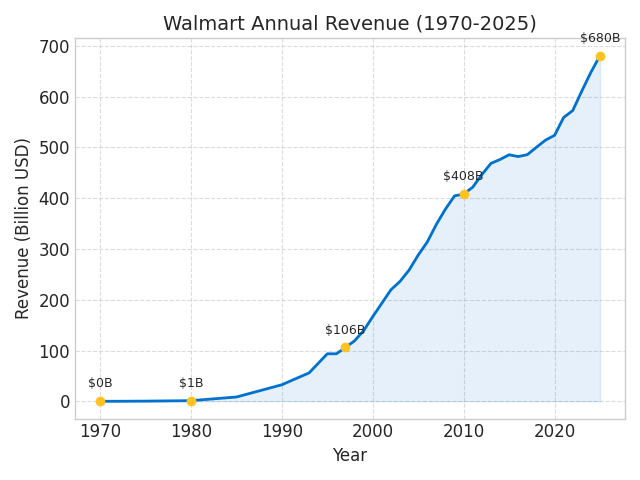
- 1979: Sales reached $1 billion annually for the first time, achieved in just 17 years since founding.
Revenue Level: From $44 million in 1970 to over $1.2 billion in 1979.
Key Business Advancement: Perfection of Cross-Docking Logistics. Walmart developed a system where products from a supplier truck were unloaded and directly loaded onto outbound trucks for stores with minimal storage time. This reduced inventory holding costs significantly, allowing the company to pass those savings to customers.
3. Innovation and Market Leadership (1980-1990): Diversification
- 1983: The first Sam’s Club opened, entering the membership warehouse club market.
- 1988: The first Walmart Supercenter opened, combining general merchandise and a full-scale supermarket.
- Technology Leadership: Walmart invested heavily in satellite communication systems and barcode scanning to revolutionize logistics.
- 1990: Walmart became the number one retailer in the United States, surpassing Sears and Kmart.
Revenue Level: From $1.6 billion in 1980 to $32.6 billion in 1990.
Key Business Advancement: Introduction of Vendor Managed Inventory (VMI). Through a historic partnership with Procter & Gamble, Walmart allowed suppliers to access their inventory data and take responsibility for replenishing their own products. This transformed the retailer-supplier relationship from a zero-sum game into a data-driven partnership.
4. Global Expansion (1991-2010): Going International
- 1991: Opened its first international store in Mexico.
- 1994-1996: Expanded into Canada and China.
- 1997: Annual sales exceeded $100 billion.
- 2002: Reached the top of the Fortune 500 list for the first time.
Revenue Level: From $44 billion in 1991 to over $400 billion by 2010.
Key Business Advancement: Launch of the Retail Link System. Walmart built a proprietary, massive database that allowed thousands of suppliers to see real-time sales and inventory levels of their products across every store. This made Walmart the most data-transparent retailer in the world, enabling a hyper-efficient global supply chain.
5. Digital Transformation and Omnichannel (2011-Present): The E-commerce Era
- Strategic Shifts: Acquired Jet.com (2016) and a majority stake in Flipkart (2018) to compete with Amazon.
- 2018: Renamed to Walmart Inc. (removing “Stores”) to reflect its transition from a physical retailer to an omnichannel giant.
- Present: Focuses heavily on AI-driven supply chains, grocery delivery services, and its Walmart+ membership program.
Revenue Level: From $446 billion in 2011 to over $670 billion for fiscal year 2025.
Key Business Advancement: Monetization of Retail Media and Fintech. Walmart launched Walmart Connect to sell digital advertising space to brands using its massive first-party shopper data. Additionally, it expanded into financial services and health clinics, shifting its business model from selling goods to managing a high-margin service ecosystem.
Sources: